



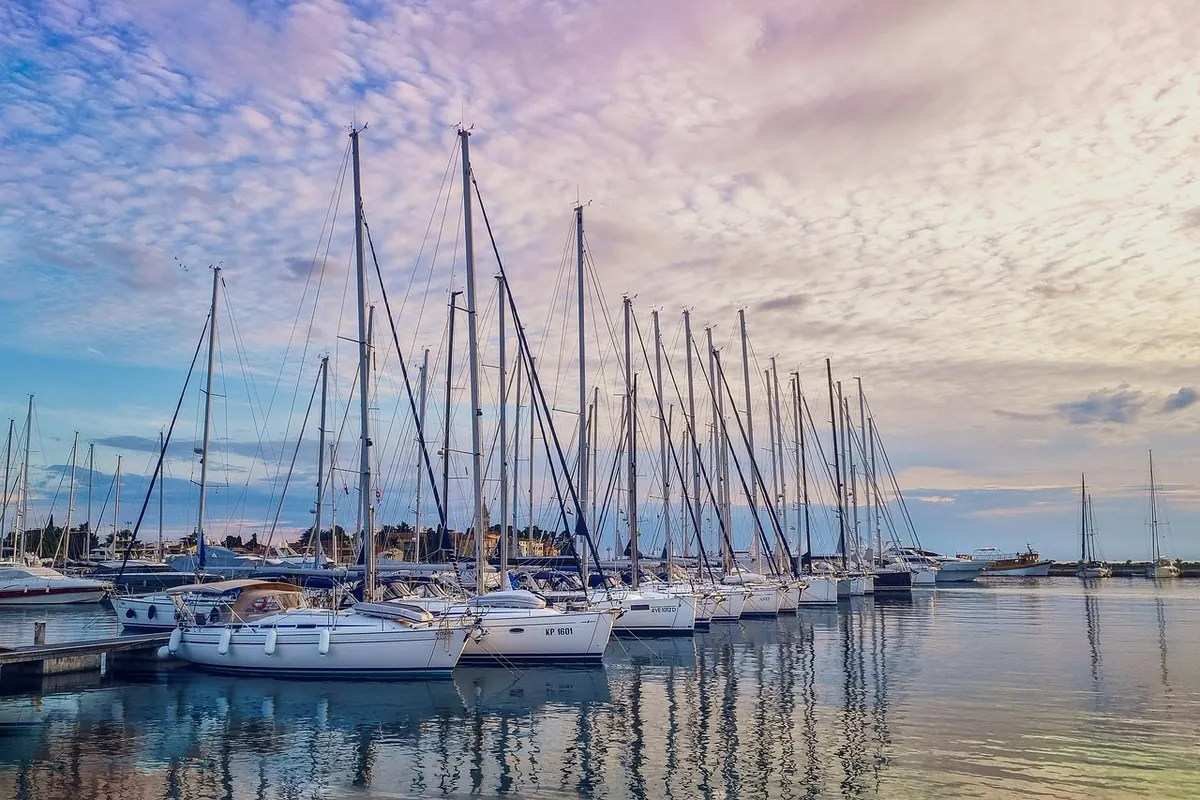


At seven in the morning, a marina is all halyards and small snaps. An ensign lifts in the breeze off the stern of a sloop, a club burgee snaps at the masthead, and a bright yellow-and-red flag hangs from a spreader on a visiting boat. None of it is decoration. Harbor flags are a practical language, and like any language, they reward a little attention. You do not need to memorize the entire International Code of Signals to understand what is happening around you. You need to know the flags that do real work, where they belong, and when to ask instead of guess.
The Flags You Notice First
Three flags do most of the visible work in a recreational harbor: the ensign, the burgee, and the courtesy flag. The ensign is the national flag of the vessel’s country, normally flown at the stern staff on a motorboat or at the stern or leech of the gaff on a sailboat. It is the boat’s primary identity flag and should be the largest and most carefully maintained flag aboard.
The burgee is the small pennant of a yacht club or sailing association, usually flown at the masthead or on a short bow staff. It says where the boat’s crew belongs, or at least which club they are visiting. A courtesy flag is the national flag of the country whose waters you are visiting. On a foreign-flagged boat, it is normally flown from the starboard spreader, smaller than the ensign and clearly subordinate to it. These three flags are not interchangeable. Flying a host nation’s flag at the stern in place of your ensign is not a courtesy; it is a misidentification.
Courtesy Flags: Small, Specific, and Easy to Get Wrong
Courtesy flags matter most when you cross a border by water. The custom is simple: fly the host country’s flag in a respectful position, usually the starboard spreader, after you have cleared in. Before clearance, some countries expect the yellow Q flag—more on that below—rather than a courtesy flag. Once you have cleared in, the courtesy flag is a quiet acknowledgment that you are a guest. It should be clean, in good repair, and smaller than your ensign.
Details vary by country and even by region. In some places, a courtesy flag is expected as soon as you enter territorial waters; in others, it goes up only after formalities are complete. The practical answer is to check the cruising guide or ask the marina office before you arrive. If you are sailing to an overseas territory, make sure you have the correct flag for that territory rather than assuming the mainland flag will do. A courtesy flag is a small piece of cloth, but it is also a small piece of diplomacy. Get it right and nobody comments. Get it wrong and everyone notices.
Signal Flags That Still Do Real Work
The International Code of Signals is a set of flags, pennants, and numeral flags that allow vessels to communicate across language barriers. Most recreational boaters never hoist a full message, but a handful of single flags remain useful and visible around harbors. These are the ones worth recognizing:
- A (Alpha): “I have a diver down; keep well clear at slow speed.” You will see this on dive boats, and you should give them room.
- Q (Quebec): “My vessel is healthy and I request free pratique.” In practice, it is flown when arriving from abroad and awaiting clearance. It is a yellow flag, and it is not a courtesy flag.
- P (Papa): The “Blue Peter,” flown as a warning that a vessel is about to put to sea. Fishing boats and ferries sometimes use it; recreational boats rarely do.
- L (Lima): “You should stop your vessel immediately.” It is a serious signal, not a marina greeting.
- O (Oscar): “Man overboard.” If you see it, treat it as an emergency and offer help.
- V (Victor): “I require assistance.”
- Y (Yankee): “I am dragging my anchor.” Useful in a crowded anchorage, and worth knowing if you are the one dragging.
- N (November) and C (Charlie): “No” and “Yes” in flag form, often used in signal exchanges.
Flags can also be hoisted in groups to spell out messages or numerals, but that is a specialized skill. For most coastal sailors, the value is recognition: knowing that the yellow flag on a newly arrived boat means something different from the red-and-white diver flag, and that neither is just a colorful accessory.
Where Flags Go, and What They Should Look Like
Position carries meaning. The ensign belongs at the stern, the burgee at the masthead or bow, the courtesy flag on the starboard spreader, and signal flags on the port spreader or below the courtesy flag if the rig allows. On a sailboat, the starboard spreader is the traditional place for a courtesy flag because it keeps the ensign clear and the masthead free for the burgee. On a motorboat without spreaders, a short staff or antenna halyard may be used, but the courtesy flag should still be visibly smaller than the ensign.
Flag etiquette is also about condition. A frayed ensign that has faded to pink is not a badge of character; it reads as neglect. Take flags down at sunset unless local custom or club rules say otherwise, and store them dry. A common yacht routine is to hoist colors at 0800 and lower them at sunset, but marina and club customs vary, so follow the local rhythm. For a memorial or death, the ensign may be half-masted: hoist it to the top, lower it halfway, and lower it completely before raising it again. Half-masting is normally reserved for the ensign, not for a club burgee or courtesy flag.
Reading the Harbor Without a Codebook
Not every flag in a marina is an official signal. Club burgees, regatta flags, sponsor banners, and owner’s private flags all share the same air. On race days, flags are part of the sailing instructions and may mean postponement, abandonment, or a change of course; they are not instructions to the whole harbor. A foreign courtesy flag tells you a boat has come from elsewhere. A Q flag tells you it may still be clearing in. A diver flag tells you to slow down and keep clear. A faded ensign tells you the owner may need a chandlery more than a lecture.
The safest habit is to watch before you act. Look at the boats around you, see which flags are flying and where, and ask the marina office if you are unsure. Harbor etiquette is not a test you pass once; it is a set of small courtesies repeated until they become routine.
A Practical Routine for New Boaters
If you are new to marina life, keep the first season simple. You do not need a full set of signal flags to be a good neighbor. You need the right flags, in the right places, in decent condition.
- Confirm which ensign your vessel should fly and mount it at the stern. Make sure it is the correct size for the boat and clear of the water.
- Fly your club burgee at the masthead or bow if you belong to a club. If you are visiting another club, ask whether a reciprocal burgee is appropriate.
- Before entering foreign waters, check the courtesy flag and clearance requirements for that country. Hoist the courtesy flag on the starboard spreader after clearance, unless local advice says otherwise.
- Learn the few signal flags that affect safety: A for divers, Q for quarantine clearance, O for man overboard, V for assistance, and Y for dragging anchor.
- Hoist colors in the morning and lower them at sunset, following local custom. Store flags dry and replace them when they fray.
- When in doubt, ask. A short question at the marina office is cheaper than an awkward explanation on the dock.
Flag etiquette is not about memorizing arcane rules. It is about signaling clearly, respecting the host country and club, and keeping your own setup tidy. Do those things, and the flags around you stop being mysterious. They become what they were meant to be: a quiet, useful language of the harbor.
Photo: ArtTower / Pixabay